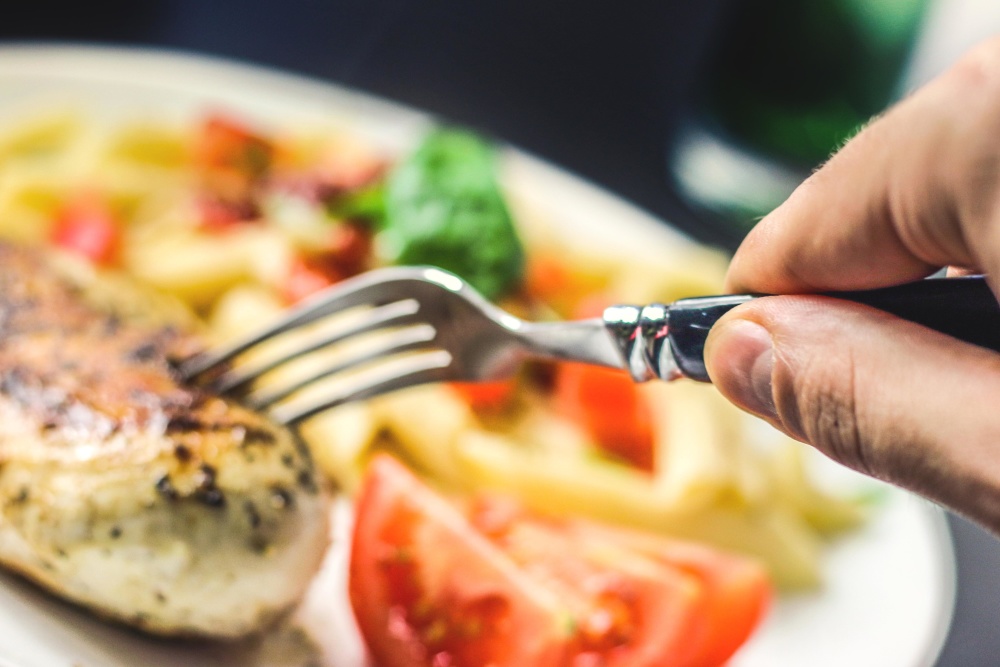
One amazing trick I learned to slow my eating down (this really works)

I’ll admit it, I’m a SUPER fast eater. I put a bite in my mouth and before that bite is even done there’s another one ready to take its place. Often I leave a meal unsure if I’m satiated or not and I tend to go by pre-planned portions as an external measure as to whether or not I’ve eaten enough. I find that especially if I am having the occasional treat like ice cream or popcorn I rush even more anticipating the next bite and never truly enjoying the bite in my mouth.

For years, I’ve advised clients to “slow down” while eating I tell myself the same message as well. Frankly, constantly catching myself rushing my meals and telling myself to slow down is boring, tedious and exhausting and hasn’t worked very well for me personally in the long run. Recently I’ve learned an amazing technique that has worked really well for me and for my clients…

The One Bite at a Time Technique

Here’s how you do it…take one bite, fully chew it (I try to chew 30 times but that doesn’t always happen) and then swallow. Then, and only then, take another bite. If you forget gently remind yourself and re-set for the next bite. When I first tried this a curious thing happened. I was actually PANICKED after the first bite or so because I was still hungry. I truly believe that fear of hunger is baked into our human consciousness so this makes sense. But, after a few bites I started feeling more comfortable and I really truly tasted my food and it was GOOD! It took me a few extra minutes to eat and, at the end, I felt totally satisfied. I didn’t have to rely on an external force to tell me how much I should eat. I felt in-touch and connected.

An added bonus is potential weight loss as medical studies suggest that chewing can alter your satiety hormones and thus decrease and help keep you satisfied for longer and thus enhance weight loss efforts.

For one entire week try this for at least one meal per day:

  1. Sit down for you meal (I insist all my clients sit while eating)
  2. Take a bite and put down your fork
  3. Chew (try for 30 times, less is ok) and swallow
  4. Pick up your fork and repeat
  5. If you make a mistake, gently remind yourself that you are re-training your brain and start again.
  6. Check in every few bites and ask yourself if you are still hungry.
  7. After you meal, check in and see how you feel. Do you feel more satisfied? Less stuffed maybe?

This is more challenging if you are mildly distracted with TV, reading or a conversation but it’s still totally possible to split your attention. I’m confident that in time this will become your habit.

Let me know how you do!
Time to ditch perfection and embrace good enough

Have you ever heard the quote “perfect is the enemy good?” It was actually popularized by Voltaire in the 1700’s so this idea has been around a long time!

I thought of this famous quote during a coaching session with a my typical working mom client a few weeks ago. She described her frustration with her lack of exercise. She had formerly been a triathlete, high school sports star and college athlete. Currently, she was working full-time and had a house full of young children. After the birth of her youngest,  she found that she wasn’t able to find time to get to the gym. Her goal was to participate in a  triathlon in one year but, meanwhile, she wasn’t doing ANY exercise at all because for her it felt like all or nothing. She believed that if she couldn’t get in her full one hour workout 5 days per week she was a failure. She kept planning and planning to get to the gym. She had even invested in a rather expensive gym membership to motivate herself but she still hadn’t set foot in the gym. She told me “I just have NO time to go.” We looked at her schedule and discovered that she had 30-45 minutes 2-3 times per week. I asked her if she would be willing to plan exercise during those times and she said “that will never be good enough to get me to my triathlon.” I quickly pointed out that at the moment she was doing ZERO exercise and asked her if that in any way was going to help her get to her goal and, of course, she had to say no. As we spoke, she realized that she had set her goals at such an impossible high for her life right now that she set herself up for failure.

Perfection: the state of being completely without mistakes or flaws

Even if this were possible –  is it something to be striven for? I LOVE mistakes. Full admission that in the moment that’s not always true – I might feel ashamed or embarrassed but upon reflection I realize they help me grow and discover amazing things. So maybe it’s more accurate for me to say that I’ve learned to embrace my mistakes. Mistakes are how we learn, how we discover new things and overall how we experience life more deeply. When I was studying painting in college, mistakes led to some of my finest paintings. Mistakes I’ve made in my personal relationships, my mothering and my work have led to some of my deepest and life-changing revelations.

Setting your goal volume all the way to perfection can be paralyzing.

You are less likely to take action at all for fear that you will never measure up. Also, it can be incredibly overwhelming to even start. And, even if you do take action, when is it ever good enough? Isn’t the process of attaining our goals just as incredible an experience as reaching them?So, if perfection is a state of things being so flawless that they cannot be improved why even set goals at all?

What to do

Like that famous commercial once said JUST DO IT. Set reasonable goals and take action every day. Reasonableness in goal setting is a very personal thing. Only you know what is possible at any one time in your life.  If you aren’t exercising at all because you used to go the gym 2 hours per day and you think if you can’t do that why bother, what about 30 minutes a day or even 10 minutes a day? If you feel overwhelmed by meal prep because you think you need to create 21 perfect meals for the week, why not try prepping 5 meals (easy recipe idea here).

Can meditation help with weight loss?

One of the secrets for weight loss I share with clients every day is the concept of mindfulness especially in terms of paying attention to your hunger signals. Like most nutritionists, I have strong opinions about the types of foods I think are the most nutritious and most likely to help with wellness and weight loss.  But, I often tell my clients, that they could eat almost any healthy diet combined with hunger mindfulness and would be able to get to their natural weight. Meditation itself is a form of mindfulness and a powerful way to learn the technique.

A second reason to practice meditation is that is acts as a stress buster.  Stress management is one of the cornerstones of weight loss is stress management. Stress can lead to weight gain for several reasons. Two most common reasons are:

1)physical: a rise in your body’s adaptive stress hormone cortisol which causes, among other things: fat deposition around your middle, a spike in your insulin, an increase in hunger especially for sweets.

2)emotional: many of us have learned to manage stress is to turn to food and alcohol to buffer our emotions.

Meditation helps to bust stress by improving your overall mood, lowering your cortisol levels as well as balancing your sympathetic (fight or flight) and parasympathetic (rest and digest).

What is meditation?

Meditation quite simply is intentional focused awareness on the present moment. It’s not about religion or a particular belief system. There is nothing mystical or magical about it. It is a way of training your mind so that you can manage your thoughts and feel more comfortable in your own skin. Meditation is a practice (not a performance) so there is no perfect way to do it. And, ANYONE can do it regardless of age or experience.

How to meditate

There are many different meditation techniques (and thousands of books, articles, blogs, podcasts, videos etc. on the subject). I’ll offer you a simple but highly effective meditation and one I often practice myself.

  1. Find a quiet space. Sit in a comfortably in a chair or on the floor (or even lying down in bed) in any position that feels natural. Prop yourself up with whatever cushions you need so you can stay in this position for at least 5 minutes.
  2. Close your eyes and notice the feeling of your body on whatever surface you are on.
  3. Begin to notice the breath moving in and out.
  4. Now, start to say to yourself on each breath in “I am breathing in” and on each breath out “I am breathing out.”
  5. Continue with this practice for 5-30 minutes (it helps to set a timer so you don’t have to worry about keeping track of time or being late for something).

While you are practicing your meditation,  your mind will likely wander (this is what the mind does). Whatever thoughts come into your head, simply label them as thoughts and come back to your awareness of the breath. When I have a thought (and it sometimes takes me a few moments to figure out that my mind has wandered), I just say to myself “thought” and return back to my breathing awareness.

Want to get some additional help with this?

Check out Peter Russel’s webpage. He has some free meditations and offers a course on a pay what you wish basis. Headspace is an app for smart phones that teaches meditation. It’s got really appealing graphics and explains the process simply and clearly. Also check out the websites of Jack Kornfield, Sharon Salzberg and Jon Kabat-Zinn who all offer workshops, free online resources and have authored many wonderful books on the subject. And, your local yoga studios, therapists and even medical practices may offer meditation workshops and classes.


Make a commitment and make it non-negotiable

One of things that came up in a group coaching call I participated in last week was the idea of making a decision or setting a goal, committing to it and following through 100 percent. My coach made this sound so simple and in a way it is.

What is a goal?

A goal is a promise of commitment you make to yourself. The more you make these promises and then follow through on them the more you build trust in yourself. During the call I realized that I made some commitments to myself around my diet and my work that I was not living up to 100%. I kept letting myself down in little ways. The more I continued to “cheat” a little bit on my commitments to myself, the less trust I started having in myself and  I kept proving to myself that I was unreliable.  Did you ever have a friend with whom you kept making plans who repeatedly didn’t show or cancelled last minute with a variety of excuses? How much trust do you now have in him or her?  It’s the same with yourself. If you decide to do something, whether it’s to lose weight, to start exercising, to write a book, to journal each morning or to floss your teeth daily decide now, commit and then make that commitment 100% non-negotiable. The more you do this, the more trust you will build.

Here’s what to do:

  1. Decide on your goal and write it down. It also helps to tell someone so you feel more accountable. Example: I am going to floss my teeth every day for the next 6 months.
  2. Make necessary plans to make it real. Example: Tomorrow, I am buying dental floss and leaving it by my toothbrush.
  3. Commit, take daily actions and make those actions non-negotiable. Example: I will continue to floss my teeth daily regardless of the circumstance.

Things comes up that appear as insurmountable obstacles (they are not)

Stuff comes up. We might decide that tonight we are too tired to floss our teeth. Or, we might decide to commit to stop consuming white flour and sugar and then we forget to do a grocery shop or we might be out with friends and that cake looks so tempting or we decide to stop drinking and a friend shows up after a break-up with a bottle of wine and we think we must drink with her. Or, we’re at a party and we don’t want to offend the hostess by turning down her homemade dessert.

I have news for you: THESE ARE EXCUSES…

they are not insurmountable obstacles. In order to get to your goal, you need to be UNSTOPPABLE. It doesn’t matter what the obstacles are, you will just figure out a way to stay committed to your goals 100%. This is the non-negotiable part.

Accept that mistakes are going to happen

Self-trust is a muscle that we build. It may take a little time so be patient with yourself. Remember, this is not about perfection. Mistakes happen and when they do, see if you can learn from them.  Beating up on yourself is not going to help you get to your goals (in fact, just the opposite).

How I’m learning to embrace overwhelm without alcohol and chocolate (or falling apart)

For the past few weeks I’ve been incredibly busy between work and my very full family life. While my typical M.O. is joyful and productive most of the time lately I’ve started to allow the feeling of overwhelm to creep in. This feeling is often followed by feelings of morning apathy – not wanting to get out of bed and night-time desire (for red wine or dark chocolate).  These feelings of apathy and desire are followed by feelings of guilt and embarrassment because I am a nutritionist, medical professional and a weight loss coach who helps others deal with their emotional eating and I’m supposed to be above all of that.

In the past, I would have handled the morning apathy by FORCING myself to get out of bed against my own will and then later in the day allowing myself to eat a carby snack like popcorn or corn chips or dark chocolate or had a glass of red wine as my reward. And, I would have hid in a virtual cave with my embarrassment about still having the occasional craving. But, I now accept that I am an imperfect human in a human body having a human experience. And, I don’t automatically reach for the wine or the dark chocolate because I’ve trained myself not to go for the food or alcohol in times of stress. I KNOW that if I eat those foods or drink that glass of wine, I won’t feel better and my problems won’t be solved, I will just get a temporary buffer from my unpleasant feelings.

I’m learning to embrace my feelings of desire and overwhelm

What I’ve come to realize is that when I get these feelings of desire (for chocolate or wine or to hide my head under the blanket) they are actually a gift from my unconscious telling me to slow down and take better care of myself. For me, the desire for these things almost always comes before I’m even aware that I’m having a stressful feeling like overwhelm. Does that happen to you too?

The desire for food is the body’s shorthand for letting me know that I need to focus on what is going on

The body only has so many ways to trigger us to pay attention to it and hunger is a big one. Except hunger is such a blunt instrument. Sure we need to eat food to fuel ourselves but what about all the other times we feel “hungry” and there is really something else going on inside (for more on how tell if you are truly hungry, check out my blog on your physiological hunger signals)? I used to resent having desires and urges and sometimes I still do but I realize now that actually they are my body’s way of saying PAY ATTENTION TO ME!

Here’s what helps

1. When you get feelings of desire whether to run and hide or eat a bag of popcorn STOP (that glass or wine or chocolate will still be waiting for you).

2. Take 2-5 deep breaths. I made a background on my smartphone to remind to intentionally breathe

Image-13. Choose an activity that sparks joy. Did you read my blog post on this and make your list yet?

4. Try quick daily journaling for 1-3 minutes every day and night. I use the 5 minute journal but there are other equally great products out there. That helps me start and finish my day off on a positive note.

5. Take one action every day towards your goals. Just one small action a day can help to offset the feeling of overwhelm.

Do the friend audit: powerful and life-changing

The key is to keep company only with people who uplift you, whose presence calls forth your best.

― Epictetus

A Different Type of Nourishment

Typically I write about how to choose the best foods to nourish yourselves to get to your health and weight goals but today, I want to talk to you about another kind of nourishment – the company you keep – who you choose to surround yourself with.  This has come up a LOT for my clients and it comes up for me a lot too. As my clients lose weight by giving up foods and habits that are not serving them, they naturally begin to evaluate other things in their life that are no longer working for them like relationships and activities that no longer serve them and decide to choose alternatives or simply let go of what is not working. You will notice that I used the word CHOOSE above because where you put your time and energy is a CHOICE. I say this to remind you that you have far more control that you realize over how much time and energy you put into other people.

Do a friend audit – right now

Go ahead and make a list of the people you spend time with.  Gary V describes this process as “auditing your circle.” This is a neutral assessment, not a judgment of anyone’s character or worth as a human being.

Do the people on your list:

  1. Inspire you ?
  2. Seem genuinely interested in what you are saying ?
  3. Seem totally happy for you when you have a success ?
  4. Leave you feeling energized, happy and vibrant ?
  5. Challenge you and tell you the truth about yourself ?
  6. Encourage you to be the best version of yourself ?
  7. Life a life you admire ?
  8. Try to change their lives to best the best versions of themselves ?
  9. DO STUFF (not just talk about it) ?

or…

  1. Do they undermine you ?
  2. Do they blow you off for a better offer ?
  3. Are they self-destructive ?
  4. Are they negative or critical ?
  5. When you share success do they try to compete with you, criticize you or bring you down ?
  6. Do they seem uninterested in your life ?
  7. Do they talk and talk but never get stuff done ?
  8. Do they pressure you to join them in activities with them that you want to drop (i.e. over drinking or eating, smoking, being unkind to others) ?
  9. Do you leave them feeling drained and uninspired ?

If you find that some or many of your relationships fall into the second set of categories do this:

  1. Consider dropping or limiting the friendships that are not serving you
  2. Decide to attract people who you admire and who inspire you
  3. Figure out how to find a person who has the qualities you are looking for – look online, take a class, any way to meet the people whose company will lift you up, not bring you down.
  4. Go out and find at least ONE PERSON who can give you the support and love you need
  5. Don’t give up! Keep looking.

As with any life shift, awareness is the first step. Remember these two things 1)you are a product of the company your keep – confidence and success are INFECTIOUS and so are apathy and insecurity and 2)you are worthy of quality people in your life.

Feeling yicky, anxious, stressed? Having food/drink cravings? Try this…

I recently tried this and it’s like a magic balm. What is it? I wrote a list of THINGS THAT SPARK JOY.  I thought maybe it was a silly exercise but I wanted to try it anyway. I sat and started writing and here’s what I came up with:

  • Spending time with my husband and kids
  • Organizing my closet, getting rid of/donating stuff (LOVE THIS MORE THAN CHOCOLATE)
  • Coaching my amazing clients
  • Exercising and practicing yoga
  • Meditation and breathing
  • Hiking and visiting the fairy houses in our local reservation
  • Listening to music (especially Beethoven, Mozart, Fleetwood Mac, The Go-Go’s or Bob Marley)
  • Reading amazing (or trashy) fiction and inspiring bios
  • Sipping really good espresso
  • Getting a massage
  • Bath with epson salt and lavender oil
  • Podcasts
  • Word puzzles, crossword, soduko
  • Sunday styles section
  • Writing in my journal (even 1-2 minutes of writing brings relief!!)
  • Meals or tea with friends
  • Learning a new craft
  • Texting a friend or family member I haven’t connected with in a while

I noticed that I have a habit of doing things that DO NOT spark joy when I’m feeling bad…

When we are feeling stressed or out-of-sorts there is likely some need in us that is not being fulfilled. After I made my list, I started paying attention. Here’s what I found: I kept trying to “fix” my feelings or escape before I even realized that I was feeling bad with things are are pretty much ineffectual and might cause more harm than good. So then I started to contemplate what I ACTUALLY do when I’m feeling stressed or lonely or bored or (fill in the blank) any unpleasant feeling.

Here’s what I was turning to for relief:

  • Facebook/instagram, check email
  • Listening to the news
  • Watching TV
  • Reading the daily newspaper
  • Yelling at my family
  • Thinking about chocolate or red wine
  • Shopping online
  • Complaining to whomever will listen (often times my poor hubbie)
  • Sitting and stewing and wishing I wasn’t feeling so icky

And, I had the a-ha moment…

These activities do not really spark much joy are not very effective in the long-term for relieving stress and anxiety. Sure shopping or taking a bite of dark chocolate might relieve stress for a minute but there is always that let-down. And, there is a time and place for shopping, eating chocolate, checking on social media or reading the paper. But, when we are feeling crappy it’s probably not the right time. More importantly, these things DON’T WORK and they tend to cause more problems than they fix.  I NEVER feel a letdown after listening to Belinda Carlisle belt out “Our Lips are Sealed” or after really taking the time to listen to my son Dan talk about the funny thing he saw online today.

The Value of a list like this

This list is a tool in your toolbox of life-management skills. Keep it handy and when you are feeling icky or stressed or uninspired, pull it out and do something on the list. Don’t just fall back into your old ways and reinforcing habits that don’t serve you. I suggest updating your list regularly (mine is on my notes app on my iphone), taking things out that don’t work for you and adding in new ideas.

Do this…

  1. Sit down and write a list of at least 10 things that spark joy for you.
  2. Notice when you are feeling blue or stressed or craving something (like chocolate or wine or pretzels or a cigarette or whatever)
  3. Look at your list
  4. Pick something on the list and do it RIGHT NOW!

Remember, your list can evolve and change. You might want to add new things or take away things that no longer are inspiring or sparking joy.

Inspire us…

What are some activities that spark joy in you? Maybe your ideas will inspire others.

6 reasons why you crave sweets (and what to do about it)

Last week I discussed sugar alternatives and why I suggest avoiding with them and getting over your reliance on sweets. This week, I’ll delve deeper into WHY we are as a nation are SO into sweets…

Here are a few of biological reasons we get hooked on sweets (and the food manufacturers know this so well):

  1. You get a dopamine kick. When we eat sweets (whether they are from sugar* or artificial sweeteners) our brains get a dopamine reward which is an intense feeling of pleasure that can become ADDICTIVE as we crave this reward we get from consuming sweets. Biologically, we are set up to receive tiny dopamine rewards but the sheer concentration of this dopamine hit is far more intense than our bodies (which haven’t evolved much in millions of years) are able to handle. And, over time, we need more and more sweets to get the same reward.
  2. You are lacking in basic nutrients which is causing cravings. Talk to your medical provider about testing your vitamin levels to make sure you are deficient in basic nutrients and consider talking to a nutrition professional to gear your diet to fueling foods that satisfy you or consider having a 20 minute (free) consultation with me to go over some of these issues.
  3. You are low in serotonin. Serotonin is a neurotransmitter that helps regulate mood. Sweets (both sugar and artificial sweeteners) indirectly raise serotonin by increasing insulin which helps the amino acid tryptophan enter the brain to make serotonin. But, there are other much better and safer ways to improve our mood than with sweets.
  4. You are eating WAY more sweeteners than you think you are (most of us are) and that is creating its own need.
*I include ANYTHING that is sweet here – fruits, “natural” sweeteners like agave or stevia as well as the artificial sweeteners like saccharin (Sweet’N Low), aspartame (Equal, NutraSweet) and sucralose (Splenda), sorbitol and Acesulfame K.

And one BIG non-biological reason (good news…you have a LOT of say in this one)…YOUR THOUGHTS which inform your DESIRE

When we feel stressed or bored or anxious we often turn to foods to numb our feelings. This is why we want sugar or chocolate or soda or popcorn (or pick your poison). When you have that desire for a sweet thing, stop and look at your thoughts. Ask yourself WHY am I having this desire? There’s usually some type of trigger such as boredom or stress. I suggest sitting with these feelings instead of immediately hitting the sweets. I PROMISE your feelings won’t hurt you.

And…here’s the good news about your biological and psychological desire for sweets…

It actually gets better over time if you stay away from the sweet stuff. And, your body will start to regulate your neurotransmitters and you will rewarded with renewed brain power and vitality. If you pay attention to your thoughts and feelings and stop trying to block them with food (or alcohol), you will give yourself the opportunity to manage your thoughts and feelings without this heavy reliance on potentially harmful (and fattening) substances.

So…should I never have sweets again?

Well, that would be a nice goal but it’s not one that I personally have. Do I ever have sugar, fruit or sweets? YES. Once in a while I do enjoy these things. They are delicious but I consume them in small quantities.

So before you indulge STOP AND THINK

So, when you get the urge for something sweet, stop and ask yourself 3 key questions:

  1. What problem am I trying to solve by having this thing? (hint…that sweet treat is probably causing more problems and not really solving any for you).
  2. Do I really want my brain to be manipulated (and potentially) harmed by what I eat and drink?
  3. Do I really NEED a substitute? Wouldn’t it be better long-term to deal with my thoughts and feelings instead (I promise they won’t harm you).

Q: what sweeteners can I use to substitute for sugar in my coffee or tea?

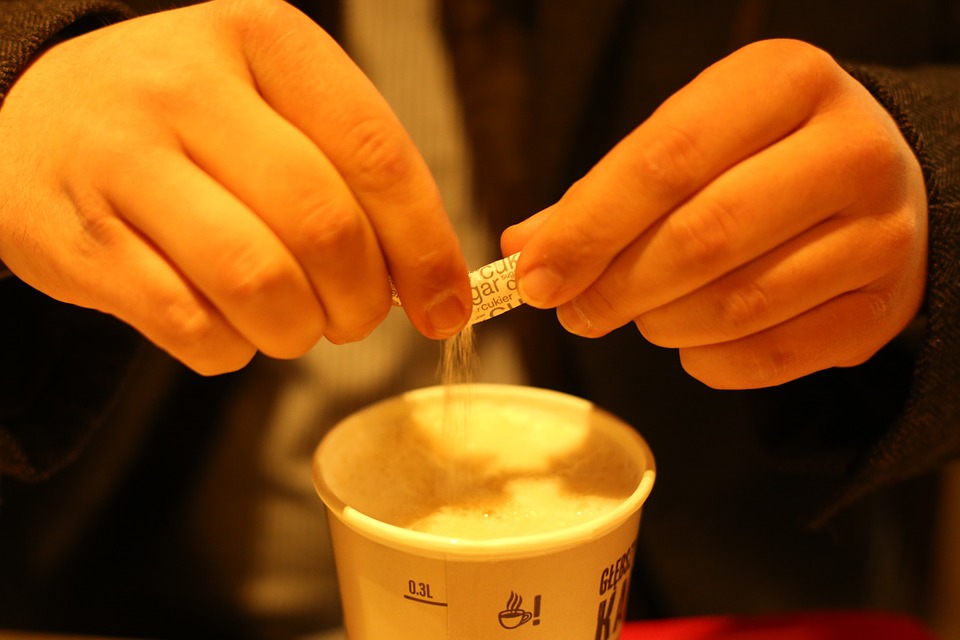
Most of my clients are aware that many sweeteners present health risks and seek alternatives that are safer types of sweeteners for their coffee or tea.  So, several times per week I get asked what sweeteners are safest to use.

Confession…I used to give people a list of sweeteners that were less horrible than say sugar or saccharin but I realized I was simply covering a gaping wound with a band-aid and not getting to the root of the issue.

So now, I ask them and I’m asking you:

WHY DO YOU THINK YOU NEED A SWEETENER AT ALL?

This is a powerful question to ask yourself. I’ve talked in previous posts about foods that fuel such as vegetables, proteins and fats. When you find yourself thinking that you NEED non-fueling foods such as sugar or flour or an alcoholic drink ask yourself WHY? What is happening in my brain that is causing to me think that I could not possible live without this substance?

Most of us are eating some for of sugar or sweetener EVERY day. I was too for many years whether it was my little piece of chocolate after dinner, that pile of grapes, gum and mints or those hidden sugars in foods such as sushi rice, cereals, crackers or ketchup. It wasn’t until I took a long hard look at myself and my reliance on sweets that I decided to (primarily) give them up and then PRESTO I lost a LOT of weight and enjoyed a myriad of other mental and physical health benefits as well.

But I CAN’T have my coffee or tea unsweetened

Well…yes you can. You just THINK you can’t. That’s all that is just a THOUGHT that you made up in your brain. It’s not a fact, it’s not even true. So, you can decide ahead of time to LIKE your coffee or tea without sweetener. Yes, just decide. If you are anything like my clients, you will quickly acclimated to the taste of the coffee or tea without sweetener and may even wonder why you ever drank it with sweetener at all. With sugar and other sweets, the more we consume, the more we want. It feels so great to free of this endless need for sweet.

Next week, I’ll explain more of why we are so addicted to sweets (and what to do about it).


Food label literacy part 3: a deeper dive into oils, sweeteners, flavorings and gums

This is the third and final installment of  3 part series on food label literacy. Today I’ll list ingredients to look out for (and avoid) on your product labels.

Be choosy with your oils

In general, I recommend consumption of the following oils: extra virgin olive oil (for salads and on veggies, not for cooking), avocado oil (for cooking or on salads), coconut oil (cooking) and ghee (cooking). There are a few other oils that are safe for consumption but this short list should cover most of your cooking needs. If you are using prepared or packaged foods below are oils you will want to avoid.

Oils to avoid

  1. Hydrogenated oils (partially hydrogenated, hydrogenated) found in many restaurants, fast foods, fried foods and packaged foods like margarine, crackers, cookies, pastries, dressings and more.
  2. Certain vegetable oils: “vegetable” oil, corn oil, canola oil, cottonseed oil, soy oil. Often found in restaurant foods, fast foods, packaged foods and condiments (like mayonnaise)

Run do not walk: MSG and MSG –like ingredients

I could write an entire book on flavor enhancers (and there are books out there on the subject such as Excitotoxins: The Taste That Kills by Russell L. Blaylock). These ingredients are often in packaged and prepared foods like frozen dinners, spice mixes, soups, soup stock and boullion.

A short list of foods that ALWAYS contain MSG (when I see these I RUN screaming): Glutamate, glutamic acid, gelatin, Monosodium glutamate, Calcium caseinate, textured protein, sodium caseinate, yeast nutrient, yeast extract, yeast food, autolyzed yeast extract, hydrolyzed protein (or any protein that is hydrolyzed).

Proceed with caution – foods that often contain MSG: Carrageenan, Maltodextrin, Malt extract, Natural pork flavoring, Citric acid, Malt flavoring, Bouillon and broth,   Natural chicken flavoring, Soy protein isolate, Natural beef flavoring, Ultra-pasteurized foods, soy sauce, stock, barley malt, soy sauce extract, Whey protein concentrate, Pectin, Soy protein, Whey protein, Protease, Soy protein concentrate, Whey protein isolate, Protease enzymes Anything protein fortified, Flavors(s) and flavoring(s), Anything enzyme modified, Anything fermented, Natural flavor(s) and flavoring(s)  Enzymes anything, “Seasonings,” hydrolyzed pea protein. Low-fat/no-fat dairy products often include milk solids that contain MSG.

Sweeteners

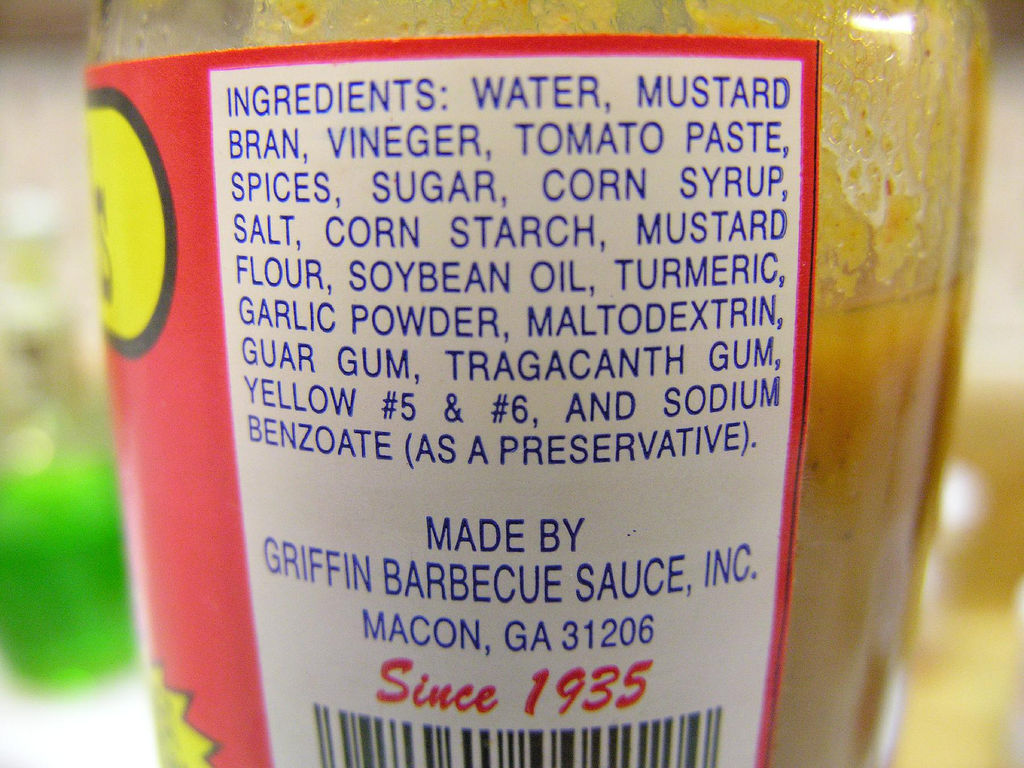
Sweeteners go by so many names and food manufacturers will sneak sweeteners into almost any kind of food (sugar in my hamburger!?). The best way to avoid sweeteners is to avoid any type of packaged foods but if you do buy packaged foods look out for the following:

Sweeteners: the bad…

Fructose, high fructose corn syrup, sugar (sucralose), honey, rice syrup, maltodrextrin, molasses, beet sugar, maltitol, glucose, agave, dextrose, evaporated cane juice, fruit juice concentrate

…and even worse…

Just when you thought it couldn’t get worse – we have artificial sweeteners. Like MSG, these are considered excitoxins and I advise avoiding these 100%: saccharin (Sweet’N Low), aspartame (Equal, NutraSweet) and sucralose (Splenda), sorbitol and Acesulfame K.

What about “safe” sweeteners

Sugar alcohols are what I normally advise my clients to use if they really need a sweetener. These include erythritol and monk fruit which come in various forms depending on your needs. Stevia, which is extracted from a plant, is also an option. More “natural” sugars such as maple syrup and honey may interfere with your weight loss efforts and are not advised for those who are diabetic. Read your labels so you can learn to avoid sweeteners and break free of your cravings!!

And, all gum and candy (except for 100% dark chocolate) have some kind of sweetener in them, oftentimes an artificial one.

Avoid food gums like xanthan and guar gums (you may disagree with me on this one)

Many milk alternatives (like coconut and almond milk) as well as other products like salad dressings, jams and jellies will often contain gums to make the product thicker. I usually tell my clients to avoid these foods (yes, there are some possible health benefits with guar gum but there are also negatives). Some of these gums include: xanthan gum, vegetable Gum, celluose gum, guar gum and locust bean gum.

If you have any questions or comments, please feel free to post below.